Monday
Dec312012

Hanging At The Shop

One of the challenges of selling directly to consumers is customer support.  Because we can't be everywhere at once, some perceive a deficiency in our ability to support customer.  After two and a half years of doing this, we actually feel pretty good about our ability to provide customer service, to the point where we think it's a big benefit.

The diversity of support we offer is pretty incredible.  From finding geometry charts of bikes that were built while Mike and I were in college (and let's just say that the socks we wore in college wore out more than a few months ago), to trouble shooting issues with equipment both ours and from other suppliers, to talking a shop mechanic through re-truing a wheel that got tweaked in a crash, to offering tire advice and training advice and congratulations after good results - it's pretty darn close to what you'd imagine some idealized shop would be like (heck we even recommend good beers), except that we aren't there in person.  Except when we are...

Imagine you broke your chain in the last laps of some cross race, and when you got to the pit some guy insisted that you take his shiny new carbon bike to finish the race.  If someone from "the shop" did that for you, you'd think it was the greatest thing ever, especially if the lender cut his own pre-ride short to do it.  Suppose you really wanted to try out a bike for size, but "the shop" wasn't going to be open at a convenient time, but "the shop" left the bike locked up out back and gave you the combo so you could try it out at a time that worked for you?  Pretty neat, huh?  Suppose you flatted at a crit and didn't have wheels in the pit, and a guy who was watching the race, a guy from a shop you'd never heard of, took the wheel off of his bike and handed it to you? 

I'm not claiming we're the be all and end all of the way things should be done.  We aren't.  Our thing at the outset was that we aimed to be a great solution for people who are comfortable enough knowing what they want to be able to get it without a lot of direct handholding through the process - basically a mail order "figure out what you need and order it" kind of a deal.  Our goal strengths were performance and reliability of product, excellence of execution, and price advantage.  Through our history, we've come to offer a whole lot more than that.  Whether it's what we write on the blog, or how we answer emails,  or say in the newsletter, or when we see you at a race, we put a lot of effort and credence into helping to educate and support bike riders and racers. 

We've been called to task for not "supporting" local racing.  We do that primarily in one really simple way - by making it about half as expensive as it would otherwise be to buy good stuff to race with.  We may not have the resources to load up the truck with neutral wheels at your race, but a big reason for that is that we're charging you a pantload less for the wheels you start the race on. If the calculus of paying three times as much so that you can get 10% back in "support" works for you, I can't argue with you.  Dad talked to me about that one a long time ago. 

There are A LOT of great shops out there, but there are also some really bad ones.  It will still be a long time before Mike and I have had as much experience at being vendors as we did at being consumers.  We've been through it from both sides of the desk, and our business was inspired by a classic "there's got to be a better way than this" response.  We still regard every customer contact as a good thing, we're excited every time we see a new "Contact Us" submission from the site.  We're not in a position to answer every question under the great blue yonder, and we're ultimately happiest helping people better equip themselves to help themselves ("teach a man to fish" and all of that), but we're happy to share our perspective, experience and opinions.

Have a Happy New Year and may 2013 be your best season yet. 


Friday
Dec282012

The Price Of Progress

11 speed Shimano drivetrains are here.  2013 Dura Ace is 11 speed, which generally means that 2014 Ultegra will be 11 speed, and 2015 105 will follow.  The DA9000 group retails for around $2,600, or about $600 more than Ultegra Di2 (which is 10 speed).  Complete bike price points for bikes with Ultegra Di2 generally start at around $4,500 with a lot of the competition happening at around the $5,000 price point, and going up to around $6,500.  Based on that, I'd expect to see a lot of DA9000 equipped bikes at around the $6,000 mark (since generally everything gets bumped up a notch when you move up a group set level). SRAM has been spotted testing a 1x11 prototype for cx, but they may be tipping their hand to road with that.  No one knows. 

If my point isn't self-evident, the stuff is expensive.  A cassette is $350, versus $210 for a DA 10 speed cassette.  There's no cheaping out with an $80 105 cassette for your training wheels because there won't be an 11 speed 105 cassette for 2 years and it probably will cost a lot more than $80 when it appears. 

The benefit of 11 speed is, well, one more gear.  From all reviews that I've read, the DA9000 group works extremely well, but of course the thing I haven't heard is how wondrous it is to have that extra gear.  There were some pretty substantive critiques of the previous DA group (7900), all of which seemed to have been addressed in the 9000 group, but the lack of an 11th gear was not a critique that I ever heard about 7900.  Shades of "answers to questions that no one was asking."

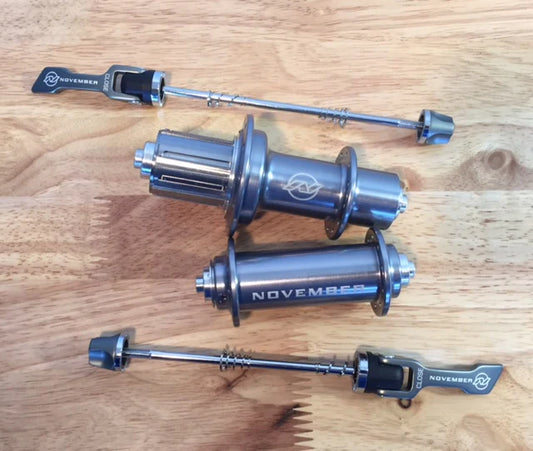
The big immediate relevance of 11 speed to most of us that it requires a different hub.  You need a wider cassette body to fit the 11 speed cassette onto, which changes the way the whole hub is laid out.  Of the hubs that we work with, White Industries has changed over completely, Chris King is about to release their 11 speed hub, and Novatec is also about to release their 11 speed hub.  Previous 10 speed White Industries hubs will not be convertible to 11 speed, while Chris King R45 hubs will be convertible with minor surgery and a re-dish of the wheel, and we're not sure about Novatec convertibility but signs point to "no."

The rub is that 11 speed hub geometry exacerbates the problem of the drive side to non-drive side tension imbalance.  This is kind of a big deal.  There's going to be A LOT of sugar coating about this, and how we've played this trick or planted this magic bean, but physics and geometry don't lie.  It will be possible to build very good 11 speed wheels, I have done so myself many times now, but every 11 speed wheel I've built so far would have been better had it been a 10 speed wheel.  

We are now building FSWs with Velocity's A23 OC rear rim.  The spoke holes in the OC are offset 4mm to the non-drive side in these rims, and this has a profound corrective effect on the side to side spoke tension imbalance.  It allows us to build 11 speed hubs with equivalent tension ratios as we could with 10 speed hubs on a centered rear rim, but it also allows us to build 10 speed hub wheels with far more even tension than we could before. 

The other thing that complicates this situation is disc brakes.  The current hub geometry and cassette body design came in coincidentally with the last frame dropout spacing change, from 126mm to 130mm, about 20 years ago.  When disc brakes come in, rear spacing is going to 135.  Bank on it.  Of course, when that happens, your current hubs, whether 10 or 11 speed, won't be disc ready.  That situation is really murky and no one can be sure of how and when what's going to happen will happen, but I'm positive that disc brakes will happen before too long, and that they will be 135mm spaced. 

I always sort of wonder when the bike riding and bike buying public is just going to throw up its collective hands and say "enough," but then I'm usually surprised at how eagerly the latest and greatest is adopted.  Your own plans for going to 11 speed will be your best guide on how to go.  Whichever way you go, the hubs are either here or just around the corner to support it.  We have plenty of 10 speed standard hubs, we'll have 11 speed standards late winter/early spring, we've got 11 speed White Industries, and Kings are a couple of weeks away at most. 


Monday
Dec242012

Yes, Mr. McGwire?

Despite the great future in plastics, rumors of aluminum's death are greatly exaggerated.  Last week's training plan was to do as little as humanly possible, but I had a heck of a good news/bad news kind of a deal yesterday, where the best way for me to be a good husband was to keep the wife company on her ride out to parts unknown.  It would be a foolish man not to see the fortune in this scenario.

In any case, after two years of nearly uninterrupted road riding on carbon wheels (incidental road usage of cross and mountain bike excepted), I did a few hours on a set of 20/24 FSWs yesterday.  It was very nice.  Compared to the RFSC38s I've been using since forever, the rear is a little bit less stiff, as you'd expect.  At 165 pounds and not very explosive, the 24 hole FSW rear is a fine match for me.  I did a few efforts in the 1100 to 1200 watt range and they responded very nicely.  I've found that the highest pedaling stress I put on wheels is jumping on climbs, accelerating hard in a moderate gear.  These did that very very well. 

Where I stress wheels out most is actually when I'm not pedaling at all, going through corners.  The best way to test that out is in crits, where you don't have unlimited line picking latitude, but I did some nice hard corners yesterday and the wheels were great. I'm excited to get some races in on these wheels and out them through that test, and I'm also going to throw some cross tires on them and head to some singletrack to see how they like that. 

It's clear that the off center rim is a real boon to non-drive side spoke tension.  At 120kgf on the drive side, it's sort of normal for me to get to 52 or 55 kgf on the non-drive on the standard symmetrical A23 rim.  That's enough to keep things nice and solid but higher tension and more balance are always good.  I've built up a bunch of wheels on the OC rim over the past week, and at my standard drive side tensions I'm getting the non-drives up to 70-74.  With the increased drive side bracing angle, the wheels have notably less give when stressed toward the non-drive side (on the bench, not the bike - the bench shows differences much more cleearly), so much so that it kind of feels like destressing a 38.  It's really nice. 

We're both still fans of spokes for a lot of reasons, but the 20/24 FSW sure is nice.  It's suitable for so much riding for so many people, and at around half the cost of even our carbon clinchers (and a lot of pre-built aluminum wheels), it's just a great option for a race wheel that you can also put huge miles on. 

Pictures are worth 1000 words but here's a cool video which is a great accompaniment to an old old post I did about how aluminum rims are made. 

Wednesday
Dec192012

7500 Carats for only $1285!

One of the things we've reluctantly had to admit is that bicycle marketing is a numbers game. Every metric a brand can attribute to its product has currency. One of the dearest is grams of course - all else being equal, fewer grams is always better. Of course, all things are not always equal with variable weight, so we see the introduction of new metrics like stiffness-to-weight ratio. Market a high stiffness to weight ratio and it almost sounds like you're marketing high stiffness and light weight at the same time, though that isn't necessarily the case. 

The metric we focus most on is price, but not in an absolute sense. Our approach to price is through value. We're not just trying to sell the least expensive carbon wheelset or SRAM Force bike. We're trying to sell the highest quality carbon wheelset and SRAM Force bike we can put together, at the lowest price we can afford. That's harder to nuance than "our prices are INSAAAAAANE!" and is no small part of the reason we spend more energy here on the blog explaining our what and why than we do with splashy ads that try to reduce our essence into a action-driving tagline with a number.

Here's an interactive quiz to today's blog: go to VeloNews right now and look at the ads, refreshing a few times to load new ones. What percentage of them are completely reliant on a tidy number to generate interest in their product? More importantly, what percentage of the ads that caught your eye lead with a number? I got to 70%. In this business, numbers speak louder than words.

Much of the game then is to figure out which metrics serve your products better than your competitors, and then pump up the relative value of that metric's currency. The wind tunnel is perhaps the most powerful tool at brands' disposal for this purpose. I'm not going to talk about how some brands abuse the metric with unrealistic testing scenarios and irrelevant comparisons (not today anyway); rather I will concede that the value of wind tunnel derived currency is high enough that we can no longer ignore it. We're in the final stages now of sending a bunch of wheels to the wind tunnel for testing, an initiative precipitated by our upcoming wide carbon clincher, which is making the trip in prototype format for some early aero feedback. We'll have much more on this in the next few weeks, including what we're sending, why we're sending it and what we learned.

My point today though is that we're not betting the farm on the wind tunnel in the way that some brands do, because very few races are contested in a wind tunnel. Our approach to a new wheel is to improve aerodynamics along with road feel, handling and acceleration - in short, to create the first wheel optimized for every single part of the race course, not just the straight flat bits. We're learning what the R&D challenges to this approach are now, but I expect the marketing will give us even more fits. The single metric that encompasses a wheel's aerodynamics, rolling resistance, inertia and handling all at once simply doesn't exist. We're not just creating a new wheel; we have to develop our own form of metrics currency to explain how well it functions. Frankly, we're not sure how we're going to do that yet. But we are pretty confident that designing a wheel for the real world instead of a measuring contest is the right way to start. 

Monday
Dec102012

Dave's Fall Wheel Blatherings Pt 2

My success or failure when I write these things is measured by "how many people who didn't know about or understand this topic will have a workable understanding of what's going on after reading this."  My goal is not to write a textbook that's on the way to a PhD in Engineering (and not even having a BS in Engineering - I have a BA in English - I'm not qualified), but to help people get a solid lay understanding of the topic.  The goal is to help people be more informed consumers and users of bike stuff.  Hopefully I'm successful in that.  This one's a bit long, so go get a cup of joe before you start.

Scratch the surface of any discussion on wheels and you will soon bump into the concept of "the bracing angle."  The bracing angle is simply the angle at which the spoke leaves the rim to travel to the hub.  Functionally, the higher it is, the better. 

There are a lot of reasons why deep section wheels (please, not "deep dish," that's wrong on several levels) feel so stiff.  A big one is that they are very stable circles.  Stand a box section alloy rim up, and push down hard on the top of it.  With not that much force, you will be able to push the top and bottom closer together, and push the sides farther apart.  A lot of people try to use this when they build wheels with alloy rims, using the spoke tension to manipulate the roundness of the rim.  It's a bad technique - if your rim is round, you are just trying to place the hub in the center of that circle, and then introduce enough tension to keep it there.  Now try the same with a deep section carbon rim.  You can push and push until the cows come home but that thing ain't going anywhere.  This kind of stiffness feels rewarding at first (among my many hypotheses is that short test rides have a great chance of leading you to a decision you'll regret, for this very type of reason), but is essentially undesired.  You feel it right away and you think "ooh, good, STIFF!, I LIKE it!" but then after a few hours you think "when can I get off this ass hatchet?"  Speed and comfort are sometimes at odds, but the speed here is thanks to the aerodynamics of the deep section rim, not the radial stiffness of that rim.  Rim makers try to make the sidewalls as thin as they can get away with both for weight and to reduce this stiffness, but at best you are minimizing and not eliminating. 

Another reason deep rims feel so stiff is the short unsupported span between the spokes.  The distance between 2 spokes on one of our RFSC85s with 24 spokes is 61.5mm.  The distance between 2 spokes on an FSW with 24 spokes is 79mm.  The distance between spokes on an FSW with 32 spokes is 59.25mm - nearly the same as on an RFSC85 with 1/4 fewer spokes.  This means each spoke is doing less work, as the circle the spokes support (the inside diameter of the rim) has many more spokes per mm of circumference supporting it.  The other diameter of the rim is supported by carbon, which is pretty balls strong (as we learned in the paragraph above, it's so strong that you're trying to actually design out some of that strength).  This is a beneficial trait in that it makes the wheel tougher, but again it can make for a pretty, shall we say, "disciplined" ride feel. 

Imagine two cardboard tubes like the ones inside a roll of paper towels.  Cut one in half, stand both up, and place the same amount of weight on each one.  Then add more weight.  The longer one will fold well before the shorter one.  Reducing the length of a column increases its stiffness.  The spokes in a wheel act as columns.  The spokes in an 85 average about 224mm in length, and the spokes in an FSW average about 290mm in length.  Big difference.  This one trends more toward the good than the bad.  I think ideally you'd have more equal column stiffnesses across all wheels (subject to the stress relieving properties I discussed in Fall Wheel Ramblings Part 1, but you don't want to just add weight and speed-robbing surface area willy-nilly.  On our newest FSW build (20/24 lacing, on an off-center rear rim), we chose to put Sapim Race spokes on the rear drive side.  It's about a 16 gram penalty, with negligible aerodynamic impact (it's pretty rare that the drive side rear spokes are in anything other than a very disturbed wind stream), but it adds measurable and palpable stiffness to the wheel.  Because spoke stiffness impacts both vaunted sides of the "laterally stiff and vertically compliant" grail, this isn't something that would benefit an 85 in the same way. 

The other thing that comes into play here is bracing angle.  Bracing angle is pretty much "the more the better."  Imagine a spoke that left the rim at 90* - you wouldn't have to pull very hard on that spoke to make the rim move toward you, but more importantly, you'd have to pull pretty darn hard against the spoke to make the rim move.  The rim is well supported.  Now imagine a spoke that leaves the rim at 0* (essentially the spoke is an exact radius of the rim).  As you pushed or pulled sideways on the rim, the rim would easily move with almost no effort.  So you see that for "lateral stiffness," the 90* spoke is good.  Front wheels get pretty good bracing angle without much work - the flanges can be set pretty wide (flange to flange distance in almost all front hubs is greater than in their rear counterparts), and the flanges are equally spaced (except in disc brakes - that's a whole other plate of nachos that we'll talk about separately).  Rear wheels are a challenge, but in short the very much reduced spoke bed circumference of an 85 from an FSW improves the bracing angle.  The short leg of the right triangle (lateral center of hub out to flange) stays the same no matter what kind of rim you put on, but the deeper rim makes the long leg of the right triangle way shorter.  That decreases the angle between the short leg and the hypoteneuse (the spoke is the hypoteneuse, get it?) sharper, and makes the angle between the long leg and the hypoteneuse (aka "the bracing angle") greater.  This is all good.  There is no bad with this.  This is one way in which deeper wheels just plain have an advantage.